Waveform Models
The waveform model is selected with:
[Model]
template = Kerr
The model is evaluated on the cropped NR time array. It returns a complex waveform whose real and imaginary parts are compared directly to the selected NR multipole.
For an introduction to the models used, see the pyRing waveforms page.
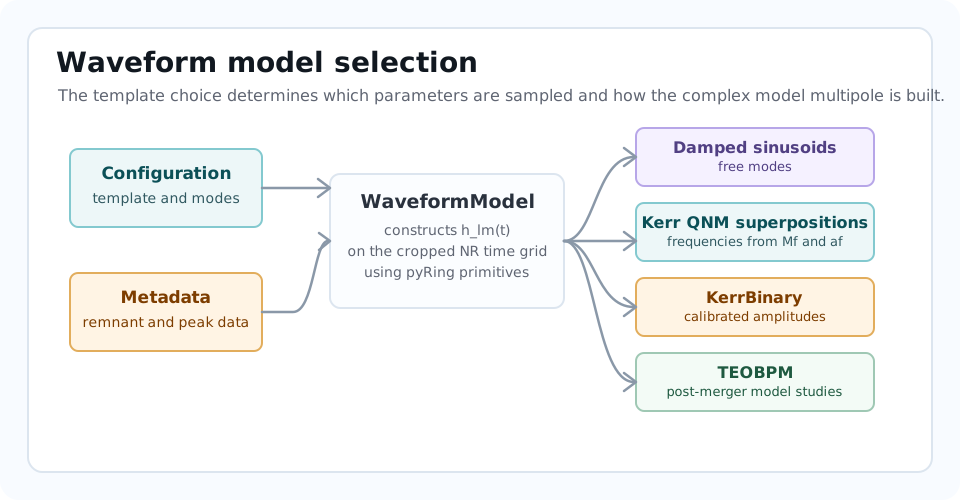
Model Selection Summary
Template |
Main free parameters |
Typical use |
|---|---|---|
|
Free amplitudes, phases, frequencies and damping times. |
Agnostic checks when QNM frequencies should not be imposed. |
|
Kerr QNM amplitudes and phases, with frequencies fixed by |
Ringdown spectroscopy on NR multipoles. |
|
Kerr QNM amplitudes plus additional free damped sinusoids. |
Residual modelling and robustness studies. |
|
Numerically calibrated QNM amplitudes superpositions. |
NR-calibrated ringdown comparisons. |
|
Merger phase, and optionally NR calibration coefficients. |
Post-merger model studies. |
Damped Sinusoids
Damped-sinusoids uses a superposition of N damped sinusoids, with
parameters:
ln_A_j
phi_j
f_j
tau_j
Use:
[Model]
template = Damped-sinusoids
N-DS-modes = 1
The default bounds are:
Parameter base name |
Default bound |
|---|---|
|
|
|
|
|
|
|
|
The prior enforces ordered frequencies for damped sinusoids. If
f_i < f_{i-1}, the nested-sampler prior is zero and the minimization path
adds a penalty residual.
Kerr QNM Template
Kerr uses the remnant mass Mf and spin af from NR metadata to
compute QNM frequencies and damping times. A linear mode is requested as
lmn:
[Model]
template = Kerr
QNM-modes = 220,221,320
For a selected mode (l,m,n), the sampled parameters are:
ln_A_lmn
phi_lmn
The complex amplitude is:
bayRing passes these amplitudes into pyRing.waveform.KerrBH with
geometric normalization, cached QNM frequencies and the NR peak time as
reference time.
The default Kerr bounds are:
Parameter base name |
Default bound |
|---|---|
|
|
|
|
QNM Frequencies
For uncharged catalogues, frequencies and damping times are computed through
qnm.modes_cache:
For charged catalogues, qf is read from the metadata and pyRing’s
Kerr-Newman interpolation utilities are used.
Negative m Modes
Negative m is encoded directly in the mode string:
QNM-modes = 220,2-20
This parses to (2,2,0) and (2,-2,0).
Quadratic QNM Terms
Quadratic terms are selected with QQNM-modes:
[NR-data]
l-NR = 4
m = 4

[Model]
template = Kerr
QNM-modes = 440,540,441,4-40,541
QQNM-modes = Px220x220,Px220x320,Px220x2-20
The format is:
P x parent1 x parent2
M x parent1 x parent2
P selects a sum-frequency term. M selects a difference-frequency term.
The child mode is assumed to be the selected NR multipole with overtone index
0. The parser warns when the requested l and m violate angular
selection expectations.
Quadratic sampled parameters use names such as:
ln_A_sum_440_220_320
phi_sum_440_220_320
or the corresponding diff prefix.
Kerr Tails
Late-time tails are enabled with:
[Model]
template = Kerr
QNM-modes = 220
Kerr-tail = 1
Kerr-tail-modes = 22
For each tail mode lm, the parameters are:
ln_A_tail_lm
phi_tail_lm
p_tail_lm
The default tail bounds are:
Parameter base name |
Default bound |
|---|---|
|
|
|
|
|
|
When tail terms are sampled, the prior orders exponents relative to the fitted NR multipole tail exponent.
Kerr-Damped-Sinusoids
Kerr-Damped-sinusoids combines the Kerr QNM parameter set with additional
free damped sinusoids. It is useful when a Kerr model captures the expected
physical QNM content but residual power needs a deliberately agnostic
component.
The sampled names are the union of the Kerr names and damped-sinusoid names.
This means a model with QNM-modes = 220,221 and N-DS-modes = 1 contains:
ln_A_220, phi_220
ln_A_221, phi_221
ln_A_0, phi_0, f_0, tau_0
KerrBinary
KerrBinary wraps pyRing’s calibrated binary-ringdown model. The available
versions are:
[Model]
template = KerrBinary
KerrBinary-version = London2018
Allowed versions in the current parser are:
Version |
Notes |
|---|---|
|
Available for |
|
Available for |
|
Uses noncircular metadata such as |
The only default sampled parameter is:
phi
with default bound [0, 2*pi]. Other quantities are read from metadata or
from calibrated pyRing internals.
For noncircular amplitudes, the option:
KerrBinary-amplitudes-nc-version = bmrg-Jmrg
selects one or two noncircular variables used by the correction fit. Allowed
variable names include bmrg, Emrg, Jmrg, Mf and af.
TEOBPM
TEOBPM wraps the TEOB post-merger model:
[Model]
template = TEOBPM
TEOB-template = HypTan
TEOB-global-fit = 1
TEOB-merger-data = 0
TEOB-template can be:
Value |
Meaning |
|---|---|
|
Hyperbolic-tangent amplitude template for quasi-circular TEOBPM fits. |
|
Rational-exponential amplitude template used for noncircular TEOBPM fits. |
TEOB-global-fit controls whether TEOB calibration coefficients come from
global fits or are sampled locally:
Value |
Meaning |
|---|---|
|
Use calibrated global fits. For |
|
Sample local amplitude and phase calibration coefficients. |
TEOB-merger-data controls the peak quantities used by TEOBPM:
Value |
Meaning |
|---|---|
|
Use quasi-circular peak fits. |
|
Use NR merger peak quantities from |
For all TEOBPM runs, the merger phase for the fitted multipole is sampled:
phi_mrg_lm
where lm is the selected NR multipole. If TEOB-global-fit = 0,
additional NR calibration coefficients are sampled. The default coefficient
bounds are:
Parameter base name |
Default bound |
|---|---|
|
|
|
|
|
|
|
|
|
|
|
|
Constant Offset
Some simulations need a small complex constant offset in the model:
[NR-data]
add-const = 0.0,0.0
The two values are amplitude and phase. Internally the code builds real and imaginary constants from that polar form and adds them to the model waveform. The default is no effective offset.
Fixing Parameters
Any sampled parameter can be fixed in the [Priors] section:
[Priors]
fix-ln_A_220 = -5.0
fix-phi_220 = 1.57079632679
Fixed parameters are removed from the sampler or point-estimate solver and injected directly into the waveform model.