Inference Methods
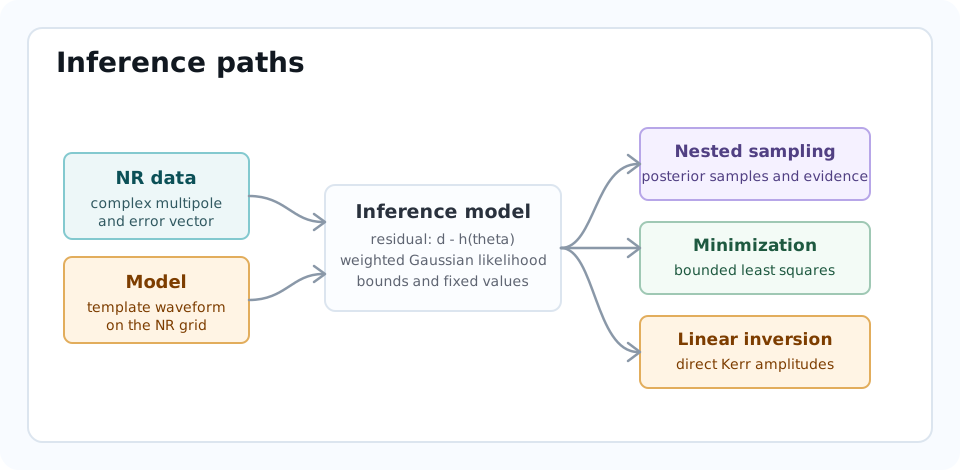
bayRing supports three inference paths:
[Inference]
method = Nested-sampler
Allowed values are Nested-sampler, Minimization and
Linear-inversion.
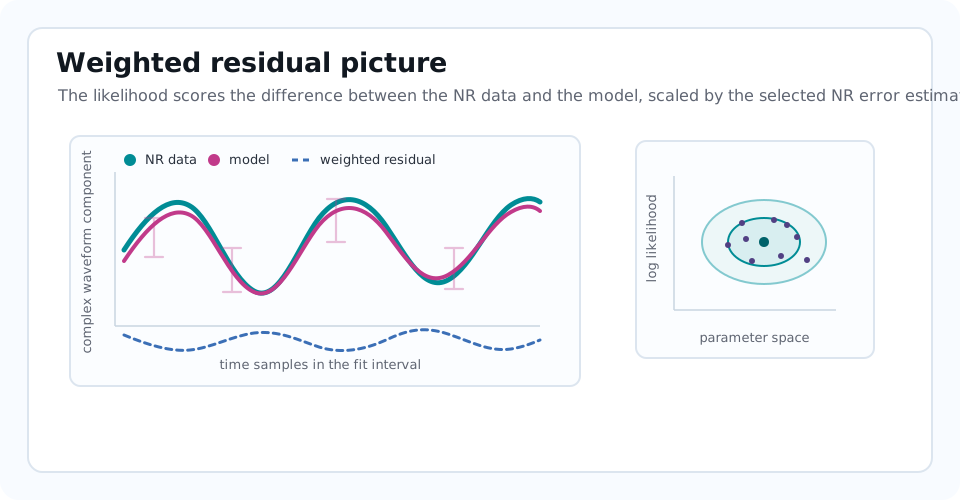
The inference target is the weighted residual between the selected NR multipole and the model evaluated on the same time samples.
Likelihood
The inference model compares a complex NR waveform d with a complex model
h(theta). The residual is:
For the default Gaussian likelihood, real and imaginary residuals are weighted by the corresponding real and imaginary parts of the NR error vector:
where epsilon = 1e-16 avoids division by zero. This is a diagonal
time-domain likelihood on the selected NR samples. PSD/ACF settings are used
later by mismatch and optimal-SNR diagnostics, not by this inference
likelihood.
Priors And Bounds
Default bounds are model dependent and are defined in
bayRing.inference.read_default_bounds. Override a bound in [Priors]:
[Priors]
ln_A_220-min = -12.0
ln_A_220-max = 0.0
phi_220-min = 0.0
phi_220-max = 6.283185307179586
Fix a parameter with:
[Priors]
fix-ln_A_220 = -5.0
fix-phi_220 = 1.0
The fixed-value syntax removes that parameter from the free parameter list. The waveform model still sees the value through the fixed-parameter override.
Non-Rectangular Prior Constraints
Some constraints are enforced in addition to simple rectangular bounds:
Model feature |
Constraint |
|---|---|
|
Frequencies are ordered by mode index. |
Kerr tails |
Tail exponents are ordered relative to the fitted NR multipole tail. |
Nested sampling applies these constraints in log_prior by returning
-inf when the constraint is violated. Minimization adds large penalty
residuals so the least-squares objective respects the same shape.
Choosing A Method
Goal |
Recommended method |
|---|---|
Quick check of a nonlinear model |
|
Fast Kerr amplitude extraction |
|
Posterior intervals and evidence |
|
Production model comparison |
|
Debugging priors and start times |
|
Point-estimate methods are excellent diagnostics, but they do not replace a posterior calculation when uncertainties, prior-volume effects or evidences matter.