Introduction
bayRing is a Python package for fitting analytical ringdown models to
numerical-relativity waveforms. The core use case is the extraction,
comparison and validation of ringdown model parameters on NR simulations, with
the same QNM conventions and waveform infrastructure used by pyRing.
The package depends on:
Waveform infrastructure:
pyRingprovides waveform interfaces and shared ringdown utilities, and thehm_nc_fitbranch ofpyRingshould be installed to usebayRing.QNM spectra:
qnmprovides Kerr QNM frequencies and damping times.Nested sampling:
cpnestandraynestprovide sampling backends.Point estimates:
scipy.optimize.least_squaresprovides the minimization backend, and the linear-inversion solver provides direct Kerr amplitude estimates.Catalogue readers: SXS, RIT, Teukolsky, cbhdb, C2EFT and related data formats are handled by catalogue-specific readers.
What bayRing Fits
bayRing fits:
NR multipole: a single complex NR multipole at a time.
Waveform components: against real and imaginary waveform components on the NR time grid.
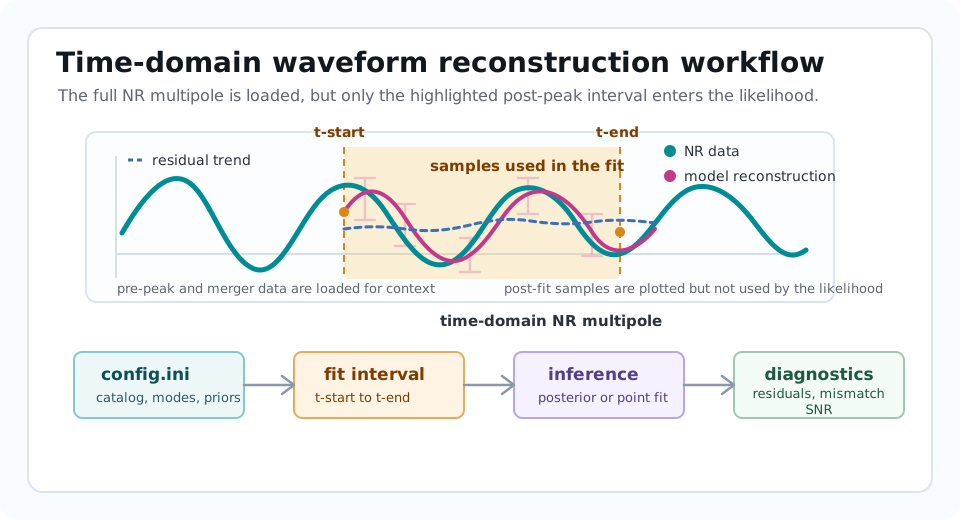
Fit interval: a cropped time interval between
t-startandt-endin units of the total massM.Uncertainty model: model residuals weighted by the selected NR error estimate.
The fitted data vector is
The crop is usually measured relative to the peak of the selected waveform amplitude. The model predicts the same complex multipole on the same time grid.
This makes bayRing useful for:
QNM amplitudes: estimate amplitudes and phases in a chosen NR multipole.
Ringdown start studies: test when constant-amplitude QNM superpositions describe a simulation over a selected time interval.
Template comparisons: compare
Kerr,Damped-sinusoids,KerrBinaryandTEOBPMtemplates.Higher modes: study higher multipoles and spherical-spheroidal mode-mixing effects.
Nonlinear and non-QNM ringdown content: validate second-order QNM contributions and late-time tail terms.
Waveform quality checks: compute mismatches and detector-scaled optimal SNR diagnostics.
Workflow At A Glance
The figure below shows the main workflow for a time-domain NR fit. The shaded region is the only part of the loaded waveform that enters the likelihood. The rest of the waveform is still useful context for peak finding, post-processing and visual diagnostics.