ROQ Workflow
The main implementation lives in JenpyROQ/jenpyroq.py. A run constructs
one or two bases depending on basis-lin and basis-qua. The linear run
uses the plus polarisation h_+. The quadratic run uses |h_+|^2 in the
main construction and validates both plus and cross polarisations.
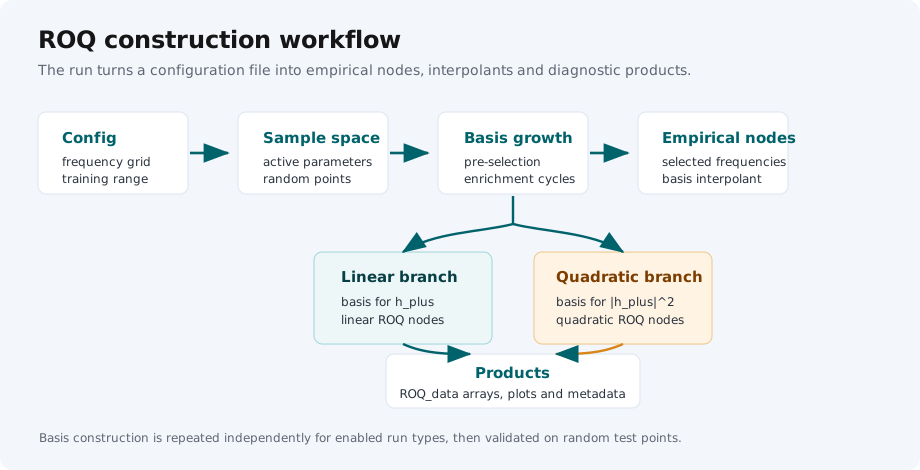
Schematic view of the ROQ construction path from configuration to stored arrays and validation plots.
Inner Product And Normalisation
The scalar product used internally is:
With optional weights w_i, both vectors are divided by
sqrt(weights) before the sum. A vector is normalised as:
If the norm is exactly zero, the code returns the original vector.
Pre-Selection Basis
The pre-selection stage is controlled by pre-basis and the
n-pre-basis-* options:
pre-basis = cornersalways starts from exactly two initial basis elements: one waveform evaluated with every active training parameter at its lower bound, and one waveform evaluated with every active training parameter at its upper bound.The corner initialisation therefore uses two opposite parameter-space points, not all
2^Ncorners of theN-dimensional training box.partial-pre-selected-basisloads the saved pre-selection basis and continues the pre-selection loop.pre-selected-basisloads the saved pre-selection basis and proceeds directly to enrichment.pre-enriched-basisloads the saved enriched basis and proceeds directly to the empirical-node and enrichment workflow.
Each pre-selection iteration then follows the same greedy search:
Draw
n-pre-basis-search-iterrandom points uniformly in the active training box.Generate one waveform per candidate point.
Project each candidate onto the known basis.
Compute the residual modulus for each projected candidate.
Select the candidate with the largest residual modulus.
Append that waveform as the next basis element.
If
gram-schmidt = 1, append the normalised Gram-Schmidt residual instead of the raw normalised waveform.Store the current basis, waveform parameters and residual history under
ROQ_data/linearorROQ_data/quadratic.Stop when the residual is below
tolerance-pre-basis-linortolerance-pre-basis-qua.Stop when the selected maximum basis size,
n-pre-basis-linorn-pre-basis-qua, has been reached.
Empirical Interpolation Nodes
After the pre-selection basis is available, the code computes empirical interpolation nodes. The first node is the index where the absolute value of the first basis vector is largest. For later basis vectors, the code solves a small interpolation system, evaluates the residual between the current basis vector and its interpolant, and selects the frequency index with the largest absolute residual.
Repeated empirical nodes are not allowed. If a candidate residual maximum is
already present in the node list, the implementation logs a warning, manually
zeros the residual at previous nodes, and chooses the next maximum. At the end
of the node update, a repeated-node check raises ValueError if duplicates
remain.
The final interpolant is:
where E is the basis matrix restricted to the number of empirical nodes and
V^+ is the pseudo-inverse of that basis evaluated at the empirical nodes.
Enrichment Cycles
Each enrichment cycle uses three aligned list entries:
training-set-sizes      = 10000,100000,100000
training-set-n-outliers = 0,0,0
training-set-rel-tol    = 0.1,1.0,1.0
For cycle i the effective tolerance is:
where r_i is training-set-rel-tol[i] and epsilon is
tolerance-lin for the linear run or tolerance-qua for the quadratic
run.
For example, if tolerance-lin = 1e-4 and the first relative tolerance is
0.1:
The cycle then:
draws
training-set-sizes[i]random parameter points;computes the interpolation error for all current outliers;
keeps only points with error above the effective tolerance;
appends the worst represented point as a new basis element if too many outliers remain;
repeats until
len(outliers) <= training-set-n-outliers[i].
Minimum Speedup Guard
During enrichment the code checks:
If the ratio falls below minimum-speedup, construction aborts. With
N_full = 259585 and minimum-speedup = 10, the largest basis dimension
allowed by this guard is:
Validation
After storing the ROQ arrays, test_roq_error draws n-tests-post random
points and evaluates the representation errors for plus and cross
polarisations. The plotted quantity is:
The validation plot is written to:
Plots/Interpolation_errors_random_test_points_<lin|qua>.pdf